(Otto Mänchen-Helfen, translated by Alan Leighton)
(Jonathan)
(Caleb)
(Anita)
(Sal)
(Sean)
(Tymek)
(Rebekah)
(David)
(Ming Ray)
(Ava)
(Delfin)
(Erick)
(Kevin)
(Lili)
(Jinjie)


∆
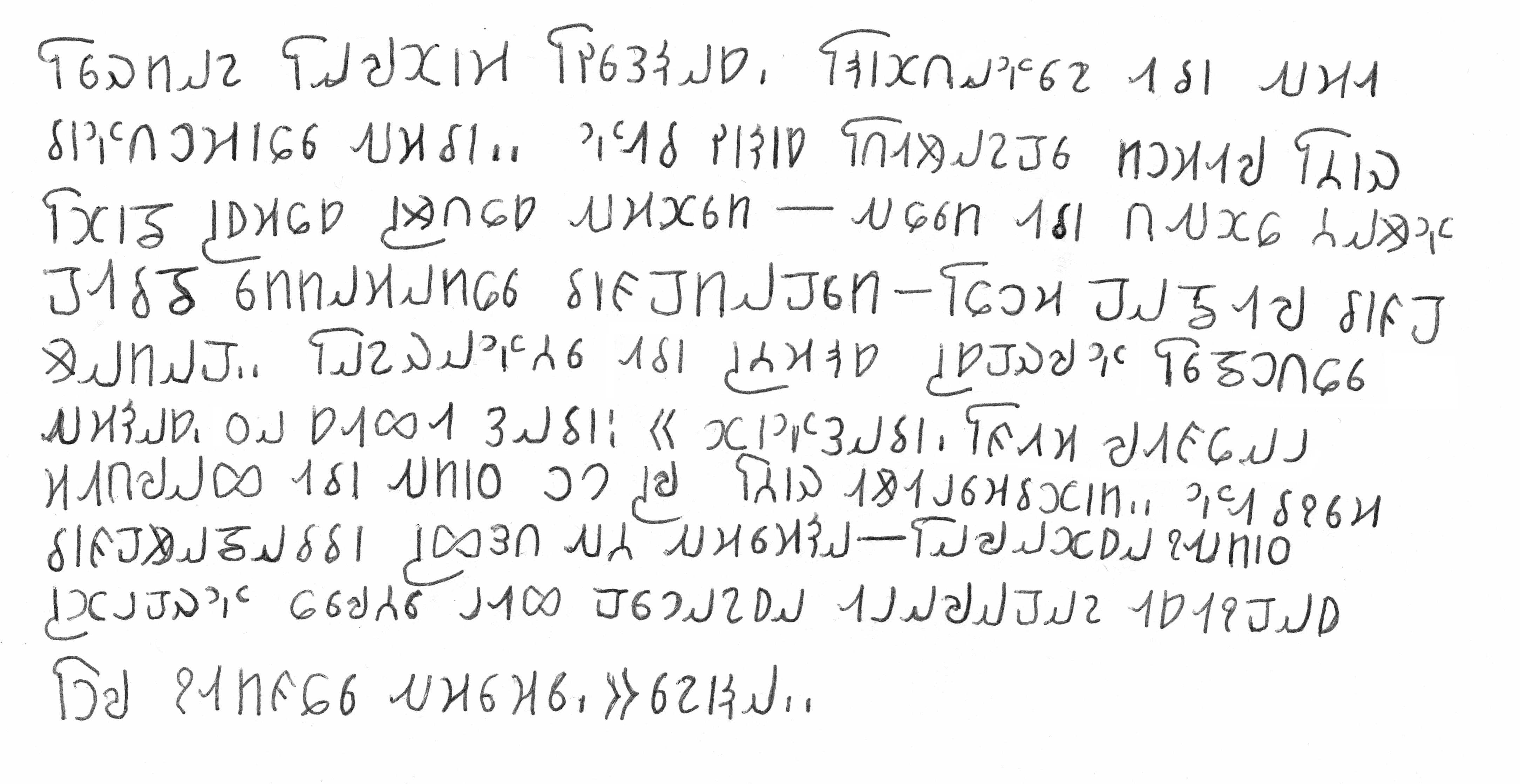
The fire smolders weakly, and I can hardly see what I am writing. Pushed together in this small yurt, we have been sitting for four hours already—my friends have smoked eight packs of cigarettes—and the conversation still has not finished. My interpreter is tired and wants to go to sleep, but I plead with him, “Please, my good Shura Rekhlov, tomorrow we’re riding for only six hours. If I don’t finish today, it will be too late—by tomorrow evening, Sandьk Syryꞑ will already be far up the Ak-Suƣ Valley.”
- Shura Rekhlov’s full name was Aleksandr Yefimovich Rekhlov. The short form is pronounced [ˈʂurɐ rʲɪxˈɫɔv̥]
- Sandьk Syryꞑ is a 20-year-old guy in this story, whose name is pronounced something like [sɑndɯ́q syrýŋ] and seems to mean “chase the trunk/chest”
- The name Ak-Suƣ is pronounced something like [ˈɑq suʁ] and literally means “white water” or “white river”.
∆
Because the fire is burning weakly, I [can] barely see what I'm writing. We've been sitting clustered close together in this small yurt for four hours — my friends have smoked eight packs of cigarettes — the conversation still hasn't finished. My translator is tired and wants to sleep, but I plead with him, saying: "please, my dear ɬekɕən ɾ̥exɬəɸ, tomorrow we will ride for only six hours. If I don't finish today it'll be too late — by tomorrow evening "Trunk Chaser" will already reach far to the end of the White Water Valley."
∆
The fire is burning low. I am barely seeing my writing. The having consumed 8 packs of cigarette friends, who were sitting close together, were still talking. Although my tired translator wanted to sleep, I said to him: “Please, my friend Alexander Retlov, we will be riding for only six hours tomorrow. We will easily be at our destination the day after tomorrow: the end of the white valley.”
∆
The good fire is burning to smallness. I see the thing I am writing with difficulty. The friends talked, after they consumed eight groups/units of cigarettes. We were sitting close to each other, we were not moving. Because my translator is tired and wants to sleep, I say to him, “Please, my friend, ætekesamə ɰexo, tomorrow we will ride six hours. We will certainly arrive the day after tomorrow with ease: the end is a white valley.”
The good fire is burning to smalowlness. I see the thing I am barely seeing my writing with difficulty. The friends talked, after thavingey consumed 8eight groupacks/units of cigarette friends,. whoWe were sitting close tog each other, we were snotill talkmoving. AlthoBecaughse my tired translator is tired and wanteds to sleep, I saidy to him:, “Please, my friend, Alætekesamə ɰexander Retlov, tomorrow we will be ridinge for only six hours tomorrow. We will certasinly barrive at our destination the day after tomorrow with ease: the end ofis thea white valley.”
∆
The good fire burns them (those little things). I write what I see with difficulty. Us friends chatted and then finished eight cigarettes. We sat together, we didn't move. Because my translator is tired and wants to go to sleep, I say, "Please, my friend, Atekesama Weho, we will be passengers for six hours tomorrow. The day after tomorrow we will easily arrive: the white valley ends.
The good fire is burns them (those little thing to smallness). I write what I see the thing I am writing with difficulty. TheUs friends tchalked, aftterd and they con finisumhed eight groups/units of cigarettes. We were siatting close to geach other, we were didno't movinge. Because my translator is tired and wants to go to sleep, I say to him, “"Please, my friend, æAtekesaməa ɰWexho, tomorrow we will ridbe passengers for six hours. We will certainly arrive tomorrow. The day after tomorrow we withll easily arrive: the end is a white valley ends.”
Note that the : after ɲiβ is a colon, the rest are length markers.
Prepositions don't translate well. 'Then' comes through more like 'later', and 'what I see' as 'that I see'. Move can also be translated as go. Neither Anita nor I translated 'with difficulty' as a prepositional phrase, but as far as I can tell there isn't a straight adverb way to say it in English.
∆
The nice fire burns them. I’m writing that I see with difficulty*. Friends were talking and later finished eight cigarettes. We sat together, we didn’t move. Because my translator is tired and wants to sleep, I say, “Please, my friend, Aleshasama Weo, we are passengers for six hours. The day after tomorrow, we will arrive easily: white valleys are the end.”
The goodnice fire burns them (those little things). I’m writeing wthat I see with difficulty*. Us fFriends chwere tattedlking and lathenr finished eight cigarettes. We sat together, we didn'’t move. Because my translator is tired and wants to go to sleep, I say, "“Please, my friend, Atlekeshasama Weho, we will bare passengers for six hours tomorrow. The day after tomorrow, we will easily arrive easily: the white valleys are the ends.”
*there is no adverb form of difficult in english
∆
The good fire burns. I write that I am seeing with difficulty. Some friends were talking and later they finished eight cigarettes. We are sitting together, we are not moving. Because my translator is tired and wants to sleep, I say “please, my friend, Alishasana Bweo, we are passengers for six hours. The day after tomorrow we will arrive: white valleys are the end.
The nicegood fire burns them. I’m writinge that I am seeing with difficulty*. FSome friends were talking and later they finished eight cigarettes. We are saitting together, we didare n’ot moveing. Because my translator is tired and wants to sleep, I say, “Pplease, my friend, Aleishasamna WBweo, we are passengers for six hours. The day after tomorrow, we will arrive easily: white valleys are the end.”
∆
Fire burns well as I write, but I write with difficulty. Some friends talk and they end eight cigarettes. Afterwards we sit together and do not move. Because my translator and I are tired, I say, “please, my friend ɑɬiʃɑsɑna fiu, we have been passengers for six hours. We will arrive in the white valley the day after tomorrow.”
∆
As the fire is burning well, I am writing, but it is difficult to see. Some friends talked and finished six cigarettes. Together we sit, and we stop moving afterwards. Because I have little energy and my translator and I want to sleep, I say, “Please, my friend Falishasana Fiyu, we have been passengers for six whole hours, and on the day after tomorrow we will arrive at the white valley.”
Notes: This is nearly identical besides some cultural changes described in the rules to the torch I was given. Some minor differences such as changing “do not move” to “stop moving” may alter the meaning a little. Since the syllable template is minimally CV, I used the voiceless bilabial fricative (I have no voiceless glottal fricative). The passage as a whole doesn’t make sense, but neither did the one I was given as far as I could tell.
∆
The fire is burning well as I write, but I see poorly. Some friends were talking and six matches¹ were used². We sit together and do not move afterward. I am tired and because my translator and I want to sleep, I say, “Please, my friend Halishasana Hiyu, the passengers had been [here] for six whole hours³, and we will arrive at the white valley eater⁴ the day after tomorrow.”
1 lit. “little fire sticks”, possibly also translatable as “twigs” or “logs”
2 lit. “ended”
3 the original text modifies “six hours” with a word translated as “to the extent that”, which does not make sense here. As such, I attempted to convey in other words what I thought was the author’s intent: a sense of incredulity at the length of time.
4 It is unclear whether this is a place name. Furthermore, the literal translation of “eater” is “one who eats”, also leaving much ambiguity.
Additional notes: Based on the morphological information given, wuSmoj has no indicators for definite or indefinite nouns. For the translation these were inferred on context.
Aside from syntax differences, the sentences saw no significant deviation from the wuSmoj.
∆
While I write the fire burning was good. But I see sleepily. We friends talked and 6 matches were consumed. Afterward we sit together and not moving. I am fatigued, and because I want to sleep, to the translator that I possess, I say, “Please, Halishasana Hiju, my friend, for six hours several passengers were here. And tomorrow we will arrive among the eaters of the white valley.”
∆
While I was doing writing¹, the fire was burning and it pleased me.² But while I watched it, I started to fall asleep.³ Then, my friends and I⁴ talked and we caused six matches to be burned.⁵ Afterwards, we sat down together, and we did not move. We were tired. And because I wanted sleep, I addressed my translator: “Imaritupi⁶, you are the friend whom I love the most.⁷ And during these six hours, we have been sitting here as passengers.⁸ Tomorrow, we will meet the eater of the white valley.”
While I was doing writeing¹, the fire was burning wand it pleased goodme.² But while I watched it, I starteed to fall asleepil.³ Then, my. We friends and I⁴ talked and 6we caused six matches to be burned.⁵ Afterwards, we sat down together, and we did not move. We were consumtired. Afterward we sit together and not moving. I am fatigued, and because I wanted to sleep, I addressed my translator: “Imaritupi⁶, you are the tfraienslatord twhatom I possess, I say, “Plovease, Halisthasana Hiju,e myost.⁷ fAnd duriend,g forthese six hours, we have been sevitting here als passengers were here.⁸ And tTomorrow, we will arrive amongeet the eaters of the white valley.”
¹ Even though the original Ɔtˤuːtˤɪv language text was in the present tense, I decided to write the Kanłän translation in the past tense, because it seems that the narrator in the text was relating a past event.
² Kanłän wan- ‘good’ has the sense of ‘not evil’, and thus would have been inappropriate in this context. It seems that narrator uses the Ɔtˤuːtˤɪv adjective sˤuɔɪxɪɣi:sˤ ‘good’ to mean pleasing.
³ There is not yet an Kanłän equivalent for the Ɔtˤuːtˤɪv adverb muɔɪlamɔɪʕu ‘sleepily’. To convey the sense that the narrator was beginning to fall asleep, but not by their own volition, the inchoative aspect was used with an experiencer subject. Thus, bew-tsu del-nuru ‘1.SG-EXP sleep-INCH’
⁴ The subject of this clause in the original Ɔtˤuːtˤɪv text was ɣixi:sˤɔɪ a:ɔɪðˤaniːvʕub, which I translated as ‘we, the friends’. There is no inclusive-exclusive distinction in Ɔtˤuːtˤɪv, but I assumed that the narrator in the text is speaking exclusively. I also reworded the subject of this sentence into ‘My friends and I’ to further clarify the use of exclusive we.
⁵ Ɔtˤuːtˤɪv has a verb ixanɔɪðix ‘to consume by fire’, which seems to be used in this context to mean ‘to light, to ignite’. Rather than creating a new word with this meaning, I used the causative with tsaysen- ‘burn’ instead.
⁶ The proper noun was rendered into Ɔtˤuːtˤɪv as iːmariθuːfɪj. [θ] and [f] are not attested in Kanłän, thus the corresponding voiceless plosives were used instead, i.e., [t] and [p] respectively. There are no phonemic long vowels in Kanłän, so those in the Ɔtˤuːtˤɪv original were rendered as short vowels. Finally, the diphthong [ɪj] is not found in Kanłän; this was replaced by [i]. The resulting Kanłän nativization of the name iːmariθuːfɪj is ‘Imaritupi’.
⁷ Kanłän has no equivalent for the honorific -ɣɔɪhiθɔɪs. The honorific is furthermore related to age-based politeness system in the culture of Ɔtˤuːtˤɪv speakers. For the Kanłän translation, this Ɔtˤuːtˤɪv cultural notion is approximated using the word tłaheł- ‘love’, which is akin to Ancient Greek φιλία <philia>.
⁸ The narrator most likely does not use the word uːnɪsˤ ‘passenger’ in a literal sense, because the setting of the text does not seem to be in some mode of transport. Thus, I used the essive case to suggest non-literal meaning.
∆
While we were writing, we were burning wood and the fire pleased me. But while we were watching it, we slept. While me and my friends were talking, we burned six matches. After that we remained and did not walk. We wanted to sleep. Because of our desire of sleep, I told my translator: ‘Imaritupi, you are our best friend. Since we remained here for six hours, let’s find each other in the white valley hopefully tomorrow.
While Iwe was doingere writing¹, we were burning wood and the fire was burning and it pleased me.² But while Iwe were watcheding it, I startwed to fall aslept. Whilep.³ Thme an,d my friends were talking, we burned six matches. After that we remained and I⁴ talked and we caused six matches to be burned.⁵ Afterwards, we sat down together, and we did not movewalk. We were tired. And because I wanted to sleep. Because of our desire of sleep, I addressetold my translator: ���Imaritupi⁶, you are our besthe friend whom I love the most.⁷ And durSingce twe remained hesre for six hours, we have been sitting here as passengers.⁸ Tomorrow, we will meet’s thefind each other ofin the white valley hopefully tomorrow.”
∆
They were writing, the wood was burning, and the fire was pleasing me. You watched them sleep. My friend and I spoke. Six of them burned, and they remained. They wanted to fall asleep, so the translator said: "O general, you are my great friend Jimalitupi. Six hours passed, and then we met. Ever since, I hope that we meet in the white valley tomorrow."
∆
They write, the wood burns, the fire pleases me.¹ You have watched them sleep before;²³ I speak with a friend. Six of them have burned before, then they have remained. They want to sleep; therefore, the translator says this: “General,⁴ you are my good friend, Jimalitupi.⁵ A quarter of the day passed, then we met. Ever since, I’ve been hoping that, tomorrow, we will meet in the white valley.”⁶
They were writinge, the wood was burnings, and the fire was pleasinges me.¹ You have watched them sleep. My fribendfore;²³ and I spoeak with a friend. Six of them have burned before, athend they have remained. They wanted to fall asleep; therefore, so the translator says thids: "O g“General,⁴ you are my greatood friend, Jimalitupi.⁵ A Sixquarter of thourse day passed, and then we met. Ever since, I’ve been hopeing that, tomorrow, we will meet in the white valley tomorrow."”⁶
¹ These three clauses were marked with a durative aspect, which I had roughly translated as “verb for a while,” but I thought that was too clunky a translation, and I left it out because in English the sense of duration is still conveyed without it.
² I have mainly left out translations of p’ɰé (then), because it is just used to make a coherent narrative since Kevin’s language is a primarily oral language.
³ Before is my best effort at translating the experiential aspect—the event has been completed, and it doesn’t apply to the present.
⁴ Military general.
⁵ I’ve combined Ji Ma Li Tu Pi into one name, since my language isn’t generally monosyllabic, like Kevin’s.
⁶ For breaking up sentences, since Kevin’s language doesn’t have punctuation, I mainly went by how he divided te text up into chunks, so I made each chunk was a sentence.
⁷ To convey the durative aspect, I’ve used the verb endings for the lexical aspect of activity.
⁸ I’ve used a combination of the past tense, perfective aspect, and accomplishment lexical aspect to convey Kevin’s experiential aspect.
∆
They write, the wood is burning, the fire pleases me. You (sg.) have watched the beings sleep; I say (together) with a friend. (When) six of them burned, then/next (3s) remained. They want to sleep, thus/therefore the translator says this thing: “Master, Yimalitupo, my great friend you are. Every fourth day they met. Ever since, they have hoped to meet at the white low land.”
They write, the wood is burnsing, the fire pleases me.¹ You (sg.) have watched them beings sleep before;²³ I spay (togeakther) with a friend. S (When) six of them have burned before, then th/neyxt have(3s) remained. They want to sleep;, thus/therefore, the translator says this thing: “GMaster, Yimalitupo, my great frieneral,⁴d you are my good friend, Jimalitupi.⁵ A quartEvery fof urthe day passed, then wey met. Ever since, I’they have been hoping that,ed tomorrow, we will meet inat the white vlow lalleynd.”⁶
(I suspect that the last line is a metaphor that means basically “to sleep”...if that is the case then I’d say “u sṇsðen ðeι-v hoϋpt ŕ-ḑif ty ð-wuιx loϋ land”, using drift to /dʐɪf.tsy/.)